



Libraries
The Romano Library
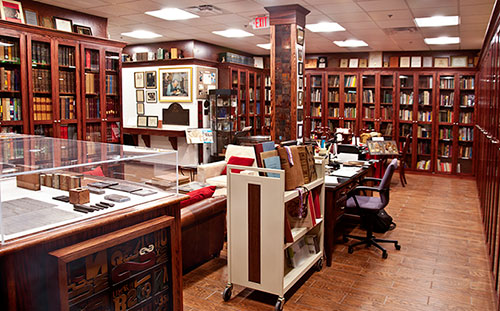
Over 6,000 books and thousands of ephemera samples are housed in a unique library which is now part of the Museum of Printing. Frank Romano has spent 60 years collecting books about printing.
There is a rare copy of Savage’s 1822 treatise on Decorative Arts and an original Dard Hunter. Complete sets of the Inland Printer and New England Printer are joined by the Penrose Annual and other publications.
Most of the collection is in 32 floor-to-ceiling custom-made mahogany bookcases with display cases that document Fred Goudy and the Nuremberg Chronicle and other aspects of print history.
An AV room stores archival slides and electronic media with vintage projectors and converters.
This Library houses the largest collection of material from the Mergenthaler Linotype Company and also maintains an archive of material from the phototypesetting and desktop publishing eras. For more info on this, please read further >
The Romano Library is augmented by:
The Frey Collection
Introductory Notes by Nancy Trottier, MOP Archivist
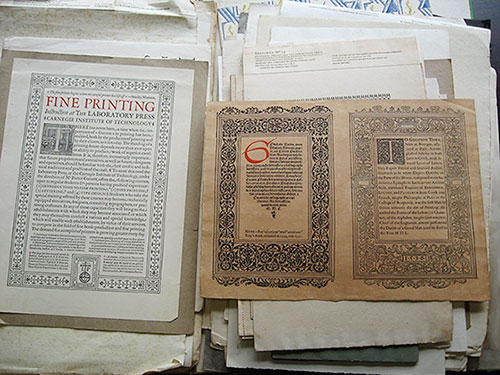
Edward J. Frey was a scholar-printer from New York. Born into a family of printers, he was also more formally educated in the New York Public School system, learning letterpress printing through their vocational technical curriculum. In the early 1920’s he himself applied for instructor positions with vocational technical programs in the same school system. He succeeded in obtaining his first teaching position with Public School #45, The Bronx, New York City, known as the Angelo Patri School.
During his 35 year long teaching career in the New York Public School system, Mr. Frey began to develop curriculum that was at once comprehensive and compartmentalized for delivery to the student. He continued this curriculum development and delivery work through his involvement with the General Studies Program at Columbia University for the next 18 years and the Adult Education Program for the Poppenhusen Institute, College Point, New York. At Columbia Mr. Frey created a Graphic Arts Technology Program for the Occupational Therapy Division of the General Studies Program. This curriculum, and those created by other printer-scholars of the 20th century, was a major building block for what many educators recognize as The Print Ed Program used widely in secondary schools and community colleges for over 60 years.
At the same time he was very involved in education, Mr. Frey also operated The Garden Press in Chappaqua, New York, from 1922 until 1978, when he entered his 95th year and decided to dispose of his library and ephemera collection and his shop equipment. During his lifetime he accumulated a huge archive of magazine articles, press and paper sample books, pamphlet books, zines, and numerous type sample catalogues. Mr. Frey, like many of the scholar-printers of the early to mid twentieth century, had a love of fine typography and kept numerous scrapbooks illustrating typographic layouts, sample proof pages, design schemes for business cards, brochures, show cards, and stationery. His family has donated Frey’s huge ephemera collection, his correspondence archive, and a good deal of his shop equipment and type, to The Printing Museum. We are the copyright holders for this collection.
We are currently actively involved in sorting through the estimated 100,000 individual pieces of the Frey collection to identify all the contents of the correspondence archive, printing samples, educational didactic material, and photographs. It is our hope over the next two years to make this vast archive of irreplaceable material available to scholars and connoisseurs of the history of printing. This page is just one visual sampling of some of the material we are discovering.
The Fowler Collection
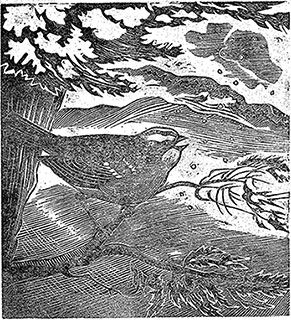 The Museum of Printing is about so much more than beautiful old printing presses, cool tools, and interesting history. Yes, we love our equipment but we’re about art too. Check out our fantastic art exhibit of Mark Fowler’s work, now on permanent exhibit.
Mark Fowler was an exceptional artist and printer. Influenced by Japanese color woodblock printing techniques, he used relief printing to share his great love of the natural world. He produced richly colored still lifes of birds, trees, flowers and landscapes, one a year, entirely by hand.
This exhibit chronologically presents 43 of his works along with displays of his sketches, engravings and blocks, tools, color palettes, progressive proofs, research materials and notes. These works on paper by a lesser-known artist will inspire printers and artists alike!
The exhibit is on view every Saturday from 10 a.m. to 4 p.m. Reasonably priced archival-quality digital reproduction prints, note cards, and letterpress impressions from Fowler’s wood engravings are available for sale in our store.
The John Trieste Memorial Type Library
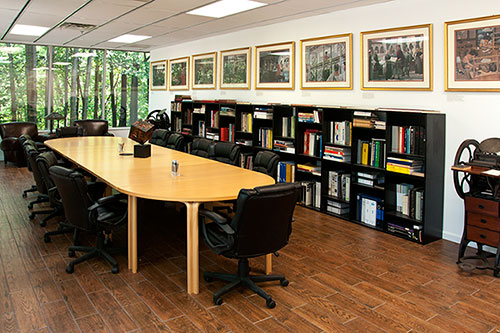
The John Trieste Memorial Library is a typographic reference library surrounded by large windows on two sides. Type specimen books, typographic publications, and other materials allow research on typefaces past and present.
It is also available as a meeting room holding about a dozen people in plush chairs around a long conference table.
The Mergenthaler Font Library
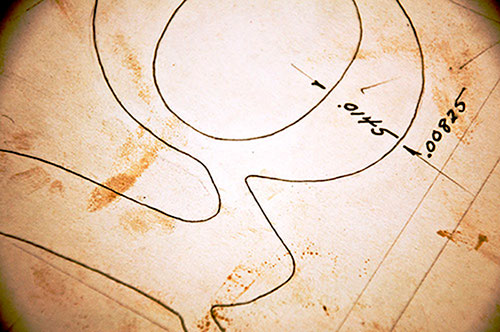
Falling under the auspices of the Richter Library is one of the world’s most unique collections, The Mergenthaler Font Library. When this large collection, about 300,000 drawings, arrived in North Andover, it arrived in one and a half trailer truck loads, 37 skids, 7 feet high. This collection came to the museum from Heidelberg International through the good efforts of the Smithsonian Institution. This collection contains all of the intricate letter drawings made by the Mergenthaler Linotype Company in Brooklyn, New York. These drawings were the starting point of manufacturing matrices for Linotype machines, enabling users to set type on these machines in 800 different languages and dialects.
The Intertype Photosetter Font Library
Much smaller than the Mergenthaler Library and yet a sizable body of work, this library represent a different medium. The Intertype Photosetter was designed during the 1940s by Intertype Corpoartion in New York in response to the steadfast march of printing, starting in about 1910, from letterpress, relief printing to offset lithography. When it became obvious to Intertype that offset lithography would eventually displace most letterpress printing and accordingly displace the necessity to manufacture lead type, the company redesigned its linecaster to manufacture phototype. They did this by mounting film alphabets into traditional Linotype matrices. The machine was 10 years in development, introduced to market in 1950. The alphabets for this machine were film positive masters, strikingly different from the pencil drawings used for earlier systems. This alphabet collection was given to the museum by Rochester Institute of Technology.
The Photon Font Library
The museum owns the remains of the Photon Library. Photon Corporation, Cambridge, Mass., was the first company to manufacture electronically driven phototypesetting machines. These machines produced type using film masters, which sent light through the masters, creating an image on photosensitive paper. This type was then photographed and eventually printed using offset lithography. Much of this collection was destroyed but the museum has enough examples to show a different medium for making type. Manufacturing phototype completed the marriage of film-based letters and offset lithography, causing a 500-year history of relief printing to come to an end.
Top ↑